
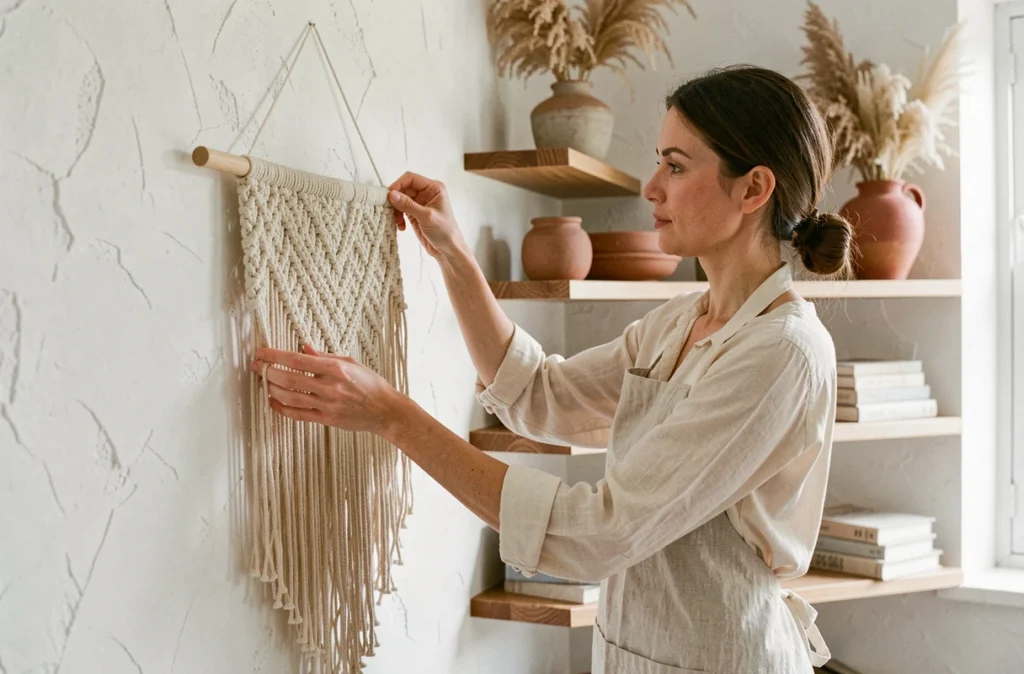
Handmade decoration is not limited to hanging a macramé on the wall. Enhancing an interior with artisanal or self-produced pieces requires choosing the right materials, mastering a few techniques, and considering each object in its spatial context. Here are ten concrete ideas, focused on material and gesture, to integrate handmade elements without falling into folklore.
1. Lime-hemp plaster with textured wall finish
A lime-hemp plaster applied as a finishing layer provides a relief that industrial paint cannot replicate. The material naturally regulates humidity and does not emit volatile organic compounds, a serious consideration given that paints, varnishes, and glues can degrade indoor air quality.
The application is done with a trowel in two passes: a grainy bonding layer, followed by a smoothing that determines the final appearance (smooth, brushed, or scraped). The finish varies depending on the sand used and the hemp dosage. Each wall becomes a unique piece without resorting to any decorative objects.
You will find many ideas to decorate your interior with Déco Maison if this material approach resonates with you and you are looking for other artisanal techniques to transpose at home.
2. Vegetable dye on vintage linen for cushions and drapes
Textile reuse is on the rise. Refashion notes that the second-hand market in France has grown in 2025, and household linen (sheets, curtains, tablecloths) is an underutilized resource for decoration.
Transforming vintage linen into cushion covers or wall hangings with vegetable dye (onion skins, avocado pits, madder) yields muted and deep shades that are impossible to achieve with synthetic dyes. Linen withstands repeated dye baths well and ages beautifully over time.
Note: reuse only has environmental benefits if it genuinely replaces a new purchase, as Refashion points out. Starting from a fabric already owned or salvaged remains the most coherent approach.

3. Rattan or willow woven pendant light
Woven materials allow for the creation of lampshades whose weaving filters and diffuses light. Raw rattan or peeled willow can be shaped over a balloon form or metal frame. The result casts graphic shadows on the ceiling and walls.
The thickness of the strands determines the transparency: thin strands (2-3 mm) create an airy mesh, while thick strands (5 mm and more) produce a more opaque volume. A technical point not to overlook: the socket must be fixed to a metal plate, never directly to the fiber, to avoid any thermal risk.
4. Cast polished concrete tray or catch-all
Polished concrete is not just for floors. Cast in a homemade silicone mold, it produces trays, catch-alls, or candle holders with a raw mineral finish. The classic mix combines white cement, fine sand, and pigment.
Final sanding with 400 then 800 grit reveals the aggregates and gives a silky touch. A microcrystalline wax finish protects the surface from stains without plastifying it. These pieces provide a visual mass that anchors a shelf or coffee table.
5. Kintsugi on recovered ceramics
Rather than throwing away a chipped bowl or vase, the Japanese technique of kintsugi involves repairing the cracks with lacquer mixed with gold powder (or brass for a more accessible version). The result transforms a flaw into a graphic line.
The application requires patience: each layer of lacquer must dry for several days before sanding. The final result is both decorative and functional, provided that a food-safe lacquer is used if the piece is to be used for serving.
6. Reclaimed wood shelf with dowel assembly
Palette or formwork wood, once planed and sanded, reveals grains and knots that new planed wood does not show. Dowel assembly with beech dowels replaces screws and brackets for a clean finish.
We prefer hard oil treatment (linseed or tung) over polyurethane varnish: the surface remains breathable and can be locally repaired in case of impact, without having to sand the entire board. The choice of finish also impacts indoor emissions, as synthetic varnish can emit pollutants for several weeks after application.
7. Candle poured in vegetable wax in a handmade container
Pouring a candle in soy or rapeseed wax into a hand-turned stoneware bowl merges two crafts. Vegetable wax burns more slowly and produces less soot than paraffin. The braided cotton wick must be sized according to the diameter of the container to avoid tunneling.
- Diameter less than 7 cm: fine braided single wick
- Diameter from 7 to 10 cm: reinforced wick or wood wick
- Diameter greater than 10 cm: double wick for even burning
8. Wall weaving in wool on a nail frame
Wall weaving goes beyond macramé in terms of textural possibilities. A wooden frame with nails spaced one centimeter apart serves as a rudimentary loom. Cotton warp threads are combined with weft threads in wool, linen, or recycled fibers.
The interplay of weaves (canvas, twill, honeycomb) creates varied reliefs on the same piece. A weaving of 40 x 60 cm is sufficient to dress a wall above a low piece of furniture and provides light acoustic insulation.
9. Open terrarium in glass assembled with copper
Assembling glass panels with copper tape soldered with tin (Tiffany technique) allows for the creation of custom geometric terrariums. Copper naturally oxidizes and develops a green patina that evolves over time.
This type of container is suitable for succulents and mosses, which tolerate the dry atmosphere of an interior. The terrarium becomes a sculptural object placed on a console or suspended in front of a window.
10. Stenciled lime wash on antique furniture
Lime wash (badigeon) adheres directly to raw or lightly sanded wood without a primer. Applied with a stencil, it allows for the reproduction of geometric or floral patterns on vintage furniture.
The finish is matte, chalky, and naturally patinas with use. The badigeon does not form a plastic film on the wood, allowing the material to breathe and limiting the emission of volatile compounds. A casein-based fixative stabilizes the pattern without altering the velvety appearance.
Each of these techniques is based on a common principle: starting from a raw or reclaimed material and giving it shape through gesture rather than purchase. The result does not resemble any catalog, and that is precisely what gives value to a handmade interior.