

In Paris, the sidewalk in front of your home is not just a piece of municipal asphalt. The departmental health regulations require residents to follow a series of concrete actions to maintain the cleanliness and safety of this space. Not knowing these rules exposes you to fines, as well as potential liability in case of an accident. Here’s what the Parisian framework actually stipulates, and how it changes daily life.
Health Regulations in Paris: What the Text Requires from Residents
The departmental health regulations in Paris are not limited to sweeping. They require occupants of adjacent properties to avoid any cause of pollution on public roads. Specifically, it is prohibited to discharge wastewater or household water onto the sidewalk or into the gutter.
This point has a direct practical consequence: if you clean your building entrance or doorstep, the washing water must not flow onto the public road. Using a water jet to push dirt towards the gutter constitutes an offense, even if the intention is to “clean.”
You can consult the detailed provisions in the resource legifrance on sidewalk maintenance which summarizes the applicable framework for Parisian residents.
The prohibition against washing your car on public roads falls under the same health regulations. It is not a maintenance obligation for the sidewalk per se, but a distinct prohibition related to washing water. Confusion between the two is common.
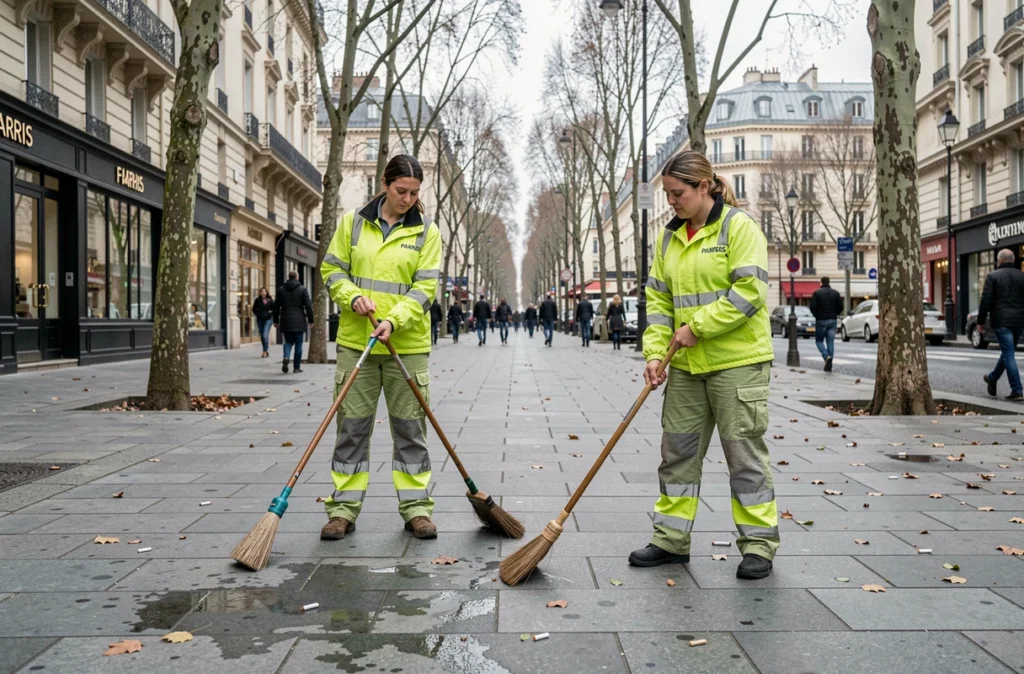
Sidewalk Cleaning in Paris: Where Resident Responsibility Ends
You may have noticed that some Parisian sidewalks are swept every morning in front of shops, while others remain covered in fallen leaves for weeks? The difference often lies in the status of the adjacent occupant and the nature of their obligation.
The resident is required to sweep in front of their property, on the portion of the sidewalk that borders it. This obligation covers regular sweeping: leaves, papers, small waste. It does not extend to roadworks or resurfacing, which fall under the jurisdiction of the City of Paris.
Property Manager and Cleaning Obligation
For a condominium, it is the property manager who organizes the maintenance of the sidewalk. In practice, they hire a service provider or assign the task to the caretaker. If no one takes care of it, the condominium can be held liable in case of an incident (such as a pedestrian slipping on wet leaves, for example).
Responsibility does not rest on an individual co-owner. It collectively engages the condominium, which justifies that the “maintenance of surroundings” item appears in the common charges.
Difference Between Cleanliness and Safety of the Sidewalk
Sweeping is one thing. Ensuring safe passage is another. If a slab is loose or if a hole forms in the surface, the resident is not required to repair it themselves. This type of degradation falls under the competence of the Paris Road Management Department.
However, promptly reporting a degradation protects the resident. Notifying municipal services as soon as a road defect is observed allows for documentation of the reporting date and clarification of responsibilities.
Fines and Sanctions for Sidewalk Maintenance Failures in Paris
Failure to comply with cleanliness obligations on public roads exposes one to fines. Agents of the City of Paris can ticket a resident who does not sweep their portion of the sidewalk or who discharges dirty water onto the roadway.
- Discharging wastewater or household water onto the sidewalk constitutes an offense under the departmental health regulations, subject to a fixed fine.
- Leaving waste on public roads (including a cigarette butt) constitutes a distinct offense, linked to the Penal Code, and not merely a failure to maintain.
Why is this distinction useful? Because a cigarette butt thrown by a passerby in front of your building does not fall under your responsibility as a resident. The offense of littering targets its author, not the owner of the neighboring building.
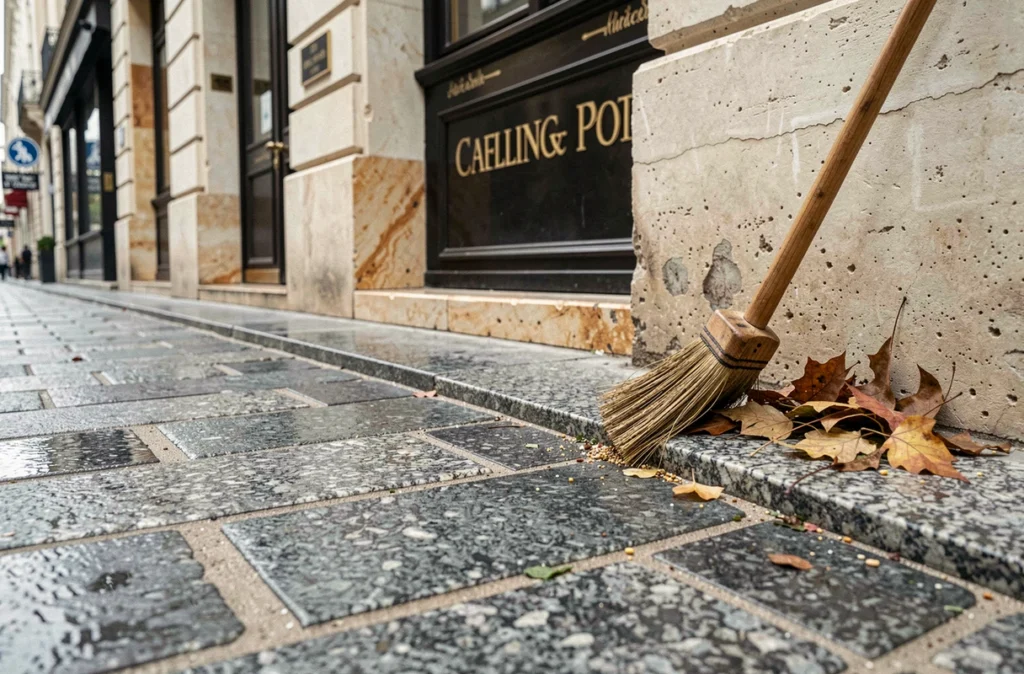
Greening and Maintenance of Sidewalks: A Balance to Find
Paris encourages the greening of public space, including at the base of trees and along the edges of sidewalks. This policy creates a hybrid situation for residents participating in these initiatives.
A resident who greens a tree base commits to maintaining the planting. Fallen leaves, overflowing soil, branches obstructing passage: all of this falls within their maintenance obligation.
- The maintenance of the planting (pruning, watering, leaf collection) is the responsibility of the resident who initiated the greening.
- If the vegetation obstructs pedestrian passage, the City can require removal or pruning.
Greening a sidewalk does not exempt one from the obligation to sweep. On the contrary, it adds an additional layer of maintenance.
Daily Management of the Sidewalk: What Falls Under the City of Paris
The municipal services ensure the mechanized cleaning of roadways and certain wide portions of sidewalks. Cleaning machines operate according to a schedule specific to each district, with varying frequencies.
The City also takes care of resurfacing, replacing damaged street furniture, and treating graffiti on public equipment. The resident is never required to finance the repair of the sidewalk themselves.
For bulky items left on the sidewalk, the City offers a collection service by appointment via its dedicated online service. Leaving a bulky item without an appointment exposes one to a ticket, even if the object is placed “neatly” against a wall.
Sidewalk maintenance in Paris relies on a clear division of responsibilities between residents and municipal services. Regular sweeping, preventing pollution, and reporting degradations are part of the daily responsibilities of each occupant. Roadworks and mechanized cleaning remain the responsibility of the City. Knowing this distribution helps avoid fines and, most importantly, protects in case of disputes with an injured pedestrian.