
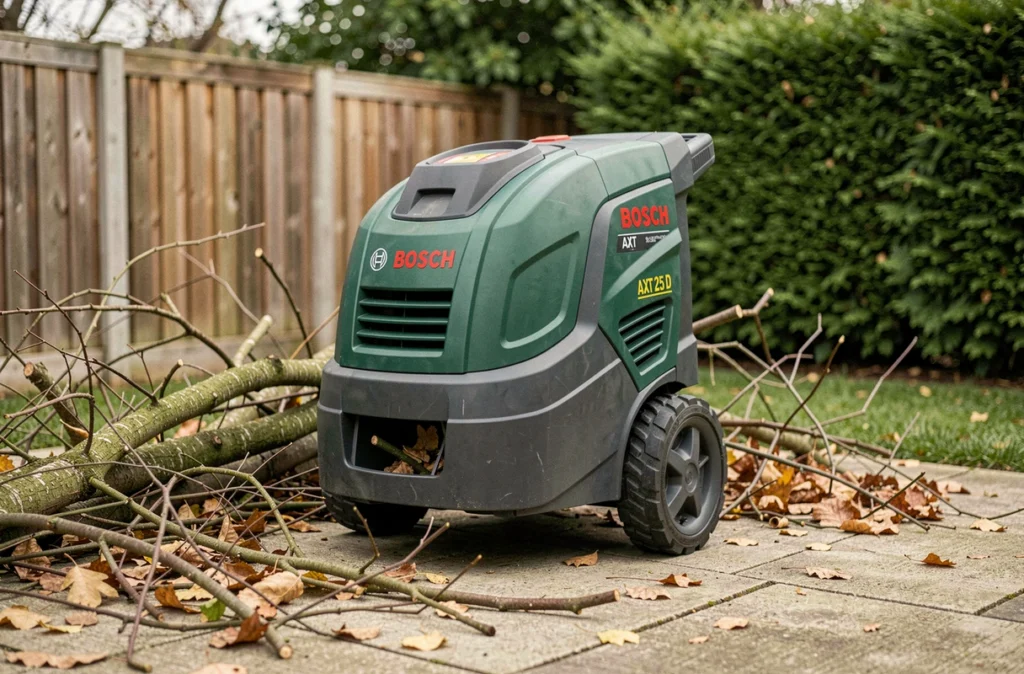
The Bosch AXT 25 D uses a knife-bearing rotor, a technical choice that clearly sets it apart from the AXT 25 TC and its turbine. This mechanical difference affects everything else: the texture of the shredded material, how the machine handles soft plant matter, noise levels and price. Understanding this cutting system helps you determine whether the machine is suited to your actual needs or simply makes promises on paper.
Bosch AXT 25 D knife-bearing rotor: how this system affects shredding
The knife-bearing rotor works like a slow-moving gear that grips branches and cuts them through progressive shearing. Unlike a turbine, which throws and breaks material apart, the rotor produces coarser, irregularly sized shreds. This has a direct impact on how the material can be used afterwards.
With small-diameter dry branches, the results are satisfactory: the chips are suitable for mulching or adding to compost. With soft or damp green waste (fresh hedge trimmings, dense foliage), the rotor is more likely to chew than cut cleanly. The resulting shreds form fibrous clumps that compact more quickly in the collection bin.
We found that the Bosch AXT 25 D shredder in our test maintains a steady feed rate on rigid branches, but you need to slow down the feed as soon as the plant material becomes soft to prevent jams. The supplied pusher helps, but does not fully solve the problem when processing large volumes of green trimmings.
Compared with the AXT 25 TC, the knife-bearing rotor offers a significantly lower price in exchange for a more modest hourly throughput. For a medium-sized garden with mixed hedges and a few shrubs, this is a worthwhile compromise. For intensive shredding or predominantly soft plant material, the 25 TC’s turbine is the better choice.
Actual noise levels: a quiet electric shredder, with some caveats
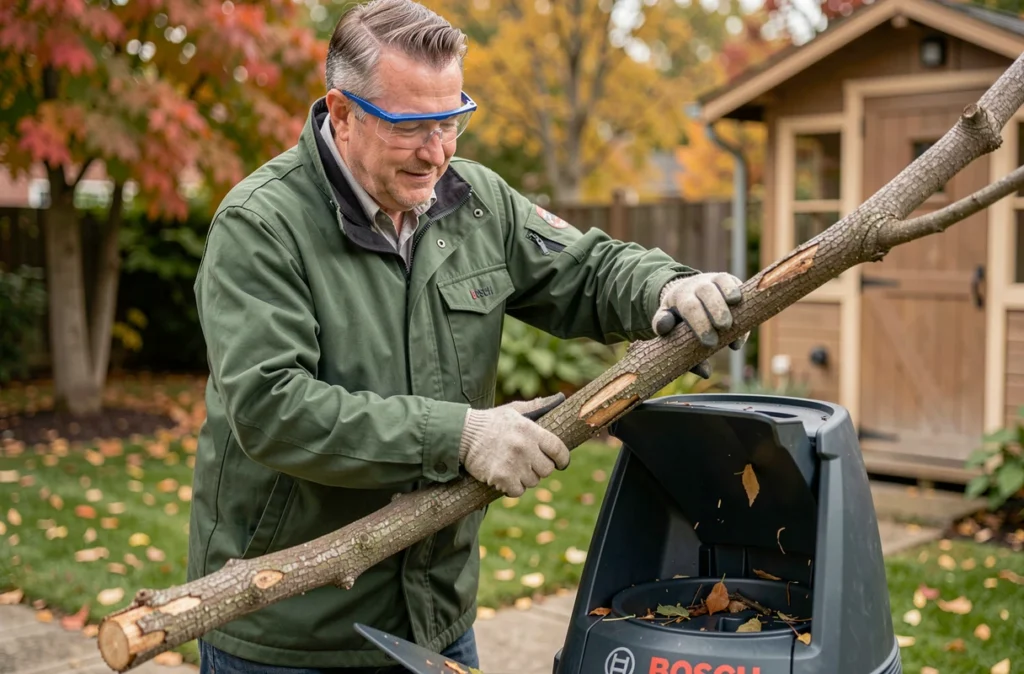
The AXT 25 D’s “quiet” label needs some technical context. The knife-bearing rotor runs at low speed, which does reduce noise compared with a high-speed blade shredder or a petrol model. When idling or shredding thin, dry wood, the machine stays within an acceptable noise range for residential use.
Things change as soon as you feed it thicker branches or green wood. The electric motor comes under load, and cutting noise adds to the sound of the motor. The noise reduction is real, but not dramatic when shredding thicker branches.
Local regulations and permitted shredding hours
One often-overlooked point: even a shredder described as quiet is still subject to local ordinances governing garden work. Permitted hours vary from one municipality to another, and noise may be considered a nuisance depending on its intensity, duration and frequency. Check local rules before shredding on a Saturday morning to avoid a fine, whatever the machine’s noise level.
Ergonomics and design: drawbacks the spec sheet won’t show
Initial assembly is quick and requires no tools. The hopper attaches to the machine body, and the collection bin clips underneath. In this respect, Bosch delivers a machine that is ready to use in just a few minutes.
The real problems emerge during extended use:
- Centre of gravity is too high: the machine tips easily on uneven ground, so you need to secure it or work on a flat surface
- Wheels are too close together: moving the machine between trimming areas becomes difficult unless the ground is perfectly flat
- The collection bin has a reasonable capacity, but fills quickly during larger trimming jobs, requiring frequent emptying
These drawbacks are not deal-breakers for occasional use. During a trimming job lasting several hours, they become tiring. The chassis design is identical to that of the AXT 25 TC, which means Bosch has not addressed this issue between the two models.
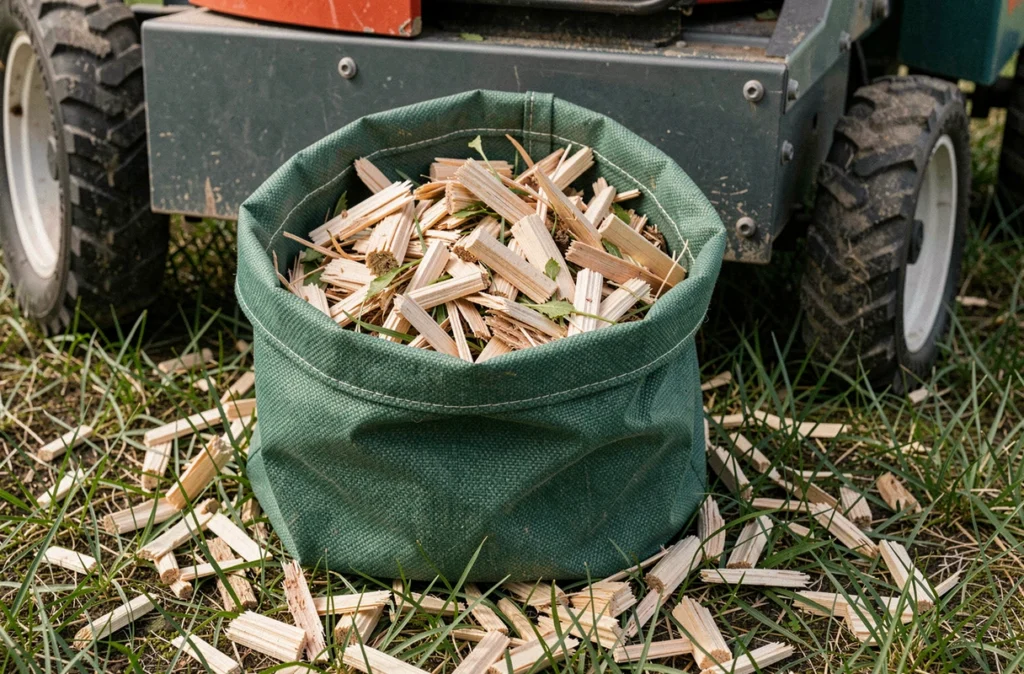
AXT 25 D shreds and ways to reuse green waste
Since separate collection of biowaste became widespread in 2024, shredding is no longer just about reducing the volume of waste sent to the recycling centre. Shreds from the AXT 25 D can be used as mulch around garden beds or added to home compost.
The texture produced by the knife-bearing rotor works well as mulch: the irregular pieces interlock and reduce evaporation. For composting, mix the shreds with nitrogen-rich materials (grass clippings, vegetable peelings) to balance the carbon-to-nitrogen ratio. Shreds made almost entirely of woody material decompose more slowly.
Ramial chipped wood (RCW) is another way to make use of the material. Spread a layer of chips from young branches over the soil to encourage biological activity. The AXT 25 D produces shreds suitable for this technique, provided you select small-diameter branches and avoid very dry deadwood.
What branch diameter should you feed in practice?
The specifications state a maximum branch diameter, but in real-world conditions, shredding becomes less comfortable well before you reach that limit. With green, knotty branches, it is best to stay below the stated diameter to maintain a smooth feed rate and protect the rotor knives.
The Bosch AXT 25 D fills a specific niche: a quiet electric shredder for residential gardens with a moderate volume of trimmings. Its knife-bearing rotor makes it less versatile than the 25 TC with soft plant material, and its manoeuvrability could be improved. For regular but non-intensive use, mainly involving dry branches and shrub trimmings, it does the job without requiring the higher investment of the turbine model.