
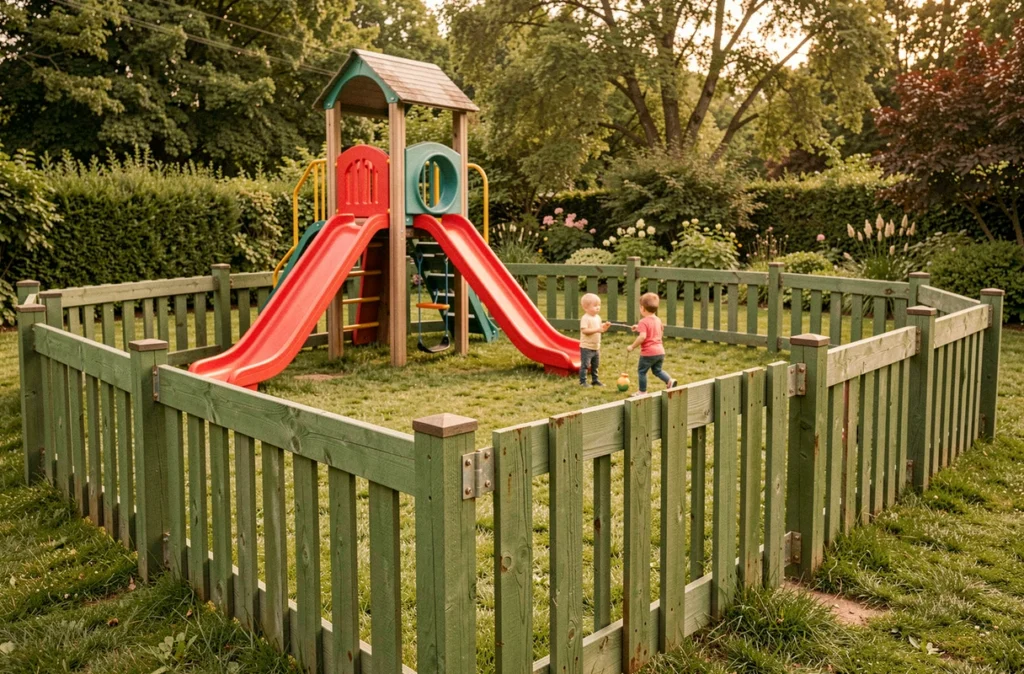
Fencing a public playground is not subject to a general regulatory requirement. The AFNOR FD S54-203 guidance document, published in March 2024, makes the need for a physical barrier dependent on a site-specific risk assessment. Nearby roads, car parks, bodies of water or steep drops are the hazards that prompt a recommendation for a barrier—not simply the presence of play equipment.
FD S54-203 guidance: assess risks before deciding to install a fence
Automatically installing perimeter fencing around every playground is a costly oversimplification. FD S54-203 first recommends maintaining a safe distance between the playground and the identified hazard. Fencing is only considered when that distance cannot be maintained, or when the site’s topography (a slope, embankment or change in level) means distance alone is not enough to stop a running child.
Typical scenarios that justify a physical barrier under this guidance include proximity to a road used by motor vehicles, a pond or watercourse with no natural barrier, and a car park with spaces directly adjoining the play area. In other situations, a dense hedge or landscaped earthworks may be sufficient.
The safety standards for the equipment itself (the EN 1176 series and EN 1177 for impact-absorbing surfacing) do not cover perimeter fencing. They define safety zones around each piece of equipment, where no hard obstacles may be placed. The specific regulatory requirements for fencing an outdoor playground therefore depend on the site context, rather than on a single piece of legislation.
Playground fencing and safety zones: design conflicts to anticipate
Installing a fence without taking the equipment layout into account can create the very risks it is meant to prevent. A child thrown from a roundabout or propelled off a slide can travel a considerable distance in the direction of travel. If the fence lies in that path, it becomes a collision hazard.
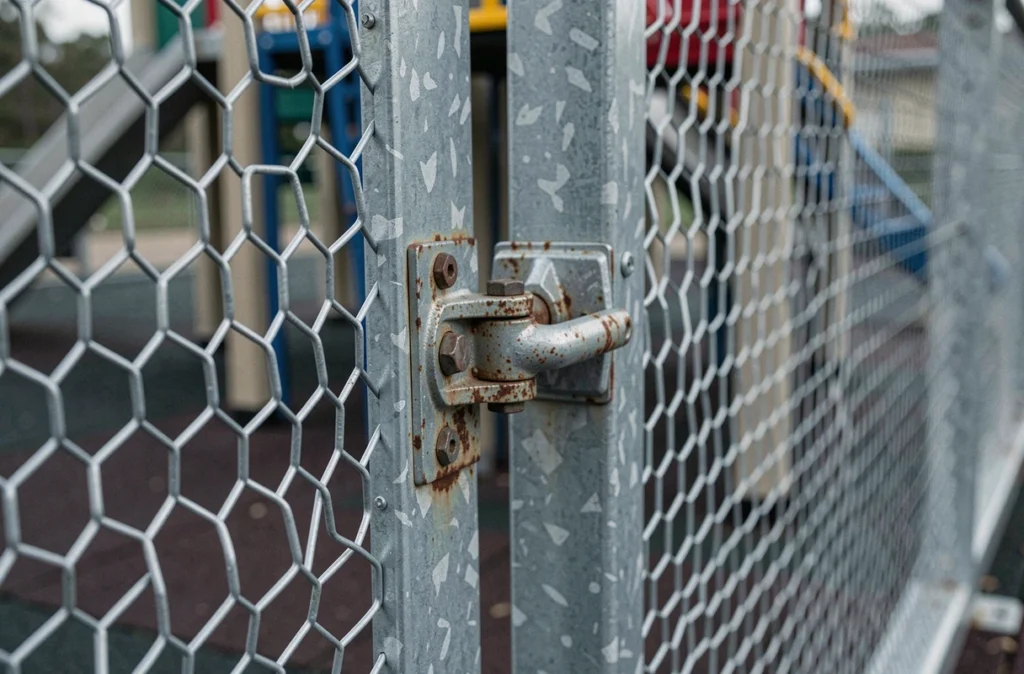
EN 1176 requires a clear area, known as the impact area and fall zone, whose dimensions vary according to the type of equipment and its free fall height. Any rigid fence installed within this area is non-compliant. Rigid welded-wire panels, widely used for their durability, are particularly problematic in this situation: their rigidity can worsen injuries in the event of an impact.
Paths and accessibility
A fenced perimeter must include accessible entrances for strollers and wheelchairs. We recommend making gates wide enough for easy passage and providing a flush threshold; otherwise, the playground may become an exclusionary space.
Gate placement also affects how people move around the playground. A single entrance facing a slide forces children entering the area to cross the landing zone. Two offset entrances facing quieter areas (benches or sandpits) reduce the risk of crossing paths.
Fence height and materials: technical criteria for public playgrounds
There is no single decree setting a minimum fence height for all playgrounds. The appropriate height depends on the site’s risk assessment and intended users. For a playground used by children under six and located near a road, a fence less than one metre high will not provide adequate containment.
- Rigid welded-wire fencing (rectangular mesh panels) offers good mechanical strength and can deter climbing if the mesh is sufficiently small, but it provides no cushioning in the event of a direct impact.
- Rolls of flexible wire mesh cost less to buy, but gradually deform under the pressure of children leaning against them. This shortens their lifespan and can create gaps where a child could become trapped.
- Pressure-treated wooden fences blend into green spaces, provided the boards are smooth and splinter-free, and the gaps between the slats are too narrow for a child’s head to pass through.
- Living barriers (hedges) provide reliable protection only if they are dense enough to physically prevent passage. A newly planted hedge can remain permeable for several years.
Fence maintenance and inspections: what site managers overlook
The fence falls within the playground operator’s inspection responsibilities, just like the play equipment. The decree of 18 December 1996 on public playgrounds imposes a general duty of safety and maintenance on the operator. A damaged fence, a gate whose self-closing mechanism no longer works or a loose post can make the operator liable in the event of an accident.
Fence inspections take place at several levels:
- Routine visual checks (weekly or more often, depending on usage): overall condition of the fence, no signs of damage, and gate operation.
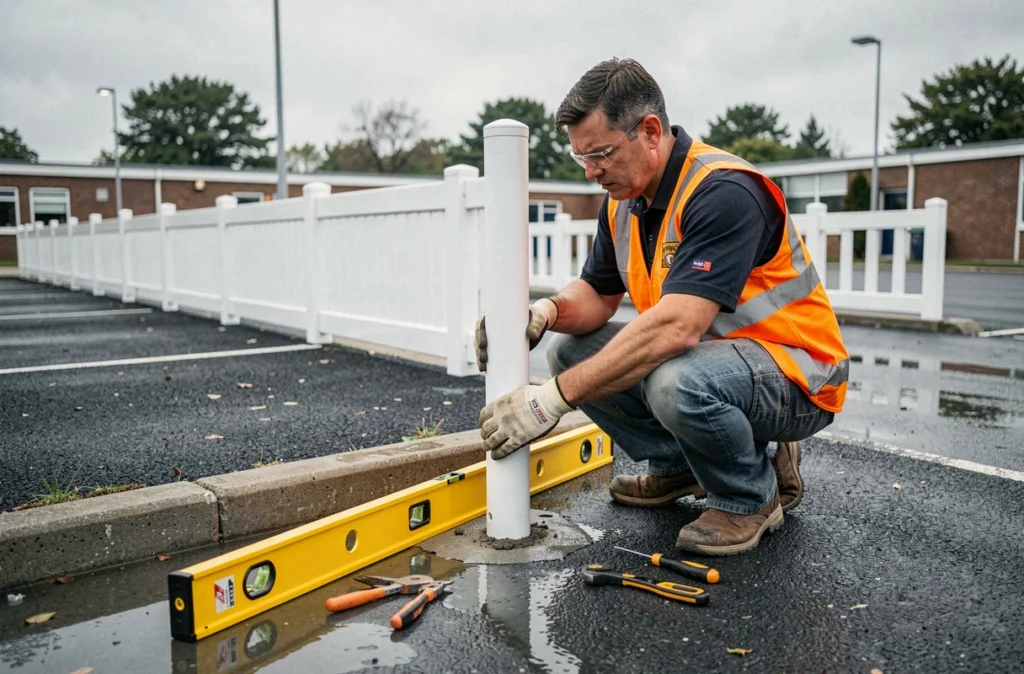
- Operational inspections (quarterly): check that posts are securely anchored, fixings are in good condition, welds show no corrosion and the mesh is taut.
- Main annual inspection: a full assessment by a qualified organisation, including whether the fence still complies with the site’s original risk assessment.
One point that is often underestimated: vegetation growing along a fence can change its properties. Dense ivy creates footholds for climbing. Branches growing through the mesh can deform the panels. Vegetation management is an integral part of fence maintenance.
Operator liability in the event of a defect
Case law holds the operator (a local authority, condominium association or private operator) liable when poor maintenance has contributed to an accident. A gate without a self-closing mechanism at a playground adjoining a car park may be enough to establish negligence.
The safety log, which is mandatory for every public playground, must record fence maintenance in the same way as work carried out on play equipment. We find that this information is often missing from the logs, weakening the operator’s position in the event of a dispute.
Fencing an outdoor playground is neither a decorative extra nor an automatic requirement. It should follow a documented risk assessment, respect the equipment’s safety zones and be covered by a maintenance plan recorded in the safety log. A poorly designed or maintained perimeter can increase risk rather than contain it.