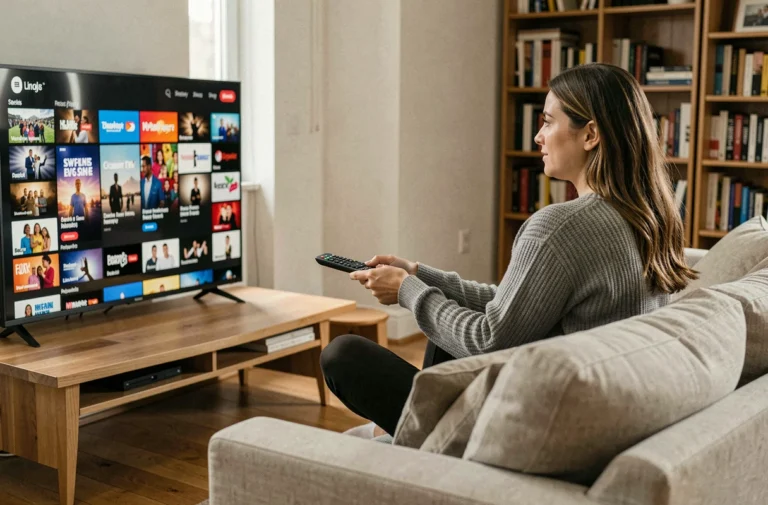
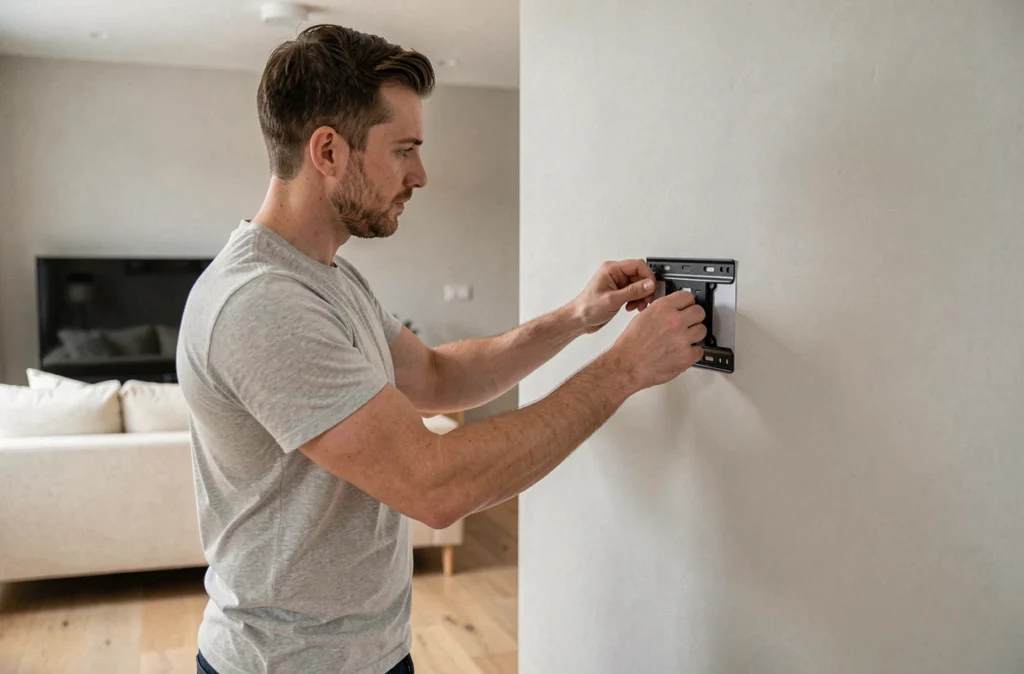
A signed lease, an empty living room, and a coaxial outlet located opposite where you want to place the screen: this situation is common in rentals. Installing a wall-mounted TV outlet or simply connecting a television to the right wall without drilling raises two distinct issues. The first is technical (how to route the signal and power). The second is legal (what the lease says about modifications to the property). Reversible solutions exist, but they are not all equal.
Coaxial outlet, fiber outlet, Internet box: what a TV outlet covers in a rental
We often refer to a “TV outlet” as a single object. In reality, the connection depends on the reception method. For collective antenna television, it is a wall-mounted coaxial outlet that distributes the signal. For Internet TV, the box acts as a decoder and connects via Ethernet or Wi-Fi, with no coaxial outlet needed.
The fiber outlet (PTO) is a special case. Arcep describes it as a termination point for the connection: moving or dismantling it is not considered ordinary DIY. The operator’s instructions must be followed, and in a rental, it’s best not to touch it without prior agreement.
This distinction changes the strategy. If the apartment already has a coaxial outlet but poorly placed, you can extend the signal with an exposed or semi-concealed cable. If you receive TV through the box, the problem reduces to positioning the box and managing the HDMI and power cables between the box and the screen. A practical guide on Concept Maison details reversible setups suitable for each configuration.
Landlord’s agreement: what the law actually allows the tenant
Article 7 of the law of July 6, 1989 sets a clear framework: the tenant cannot alter the premises or their equipment without the written consent of the landlord. Adding a built-in outlet or modifying the electrical circuit falls into this category.
In practical terms, attaching a duct with adhesive or laying a cable along a baseboard does not constitute an alteration. Creating a groove in the drywall to embed a coaxial cable, however, does. The line is drawn between reversible modifications (which can be removed without a trace) and structural or electrical changes.
If you plan to hire an electrician to add a connection point, the cautious approach is to obtain written consent from the owner, specifying who will finance the work and what must be restored upon departure. A simple email exchange is legally sufficient, provided you keep proof.
Cables and TV mounts without drilling: reversible setups that hold
The real challenge in a rental is not mounting a screen (a TV stand suffices), but hiding the cables without opening the wall. Three reversible approaches work depending on the living room configuration.
Adhesive duct along the wall
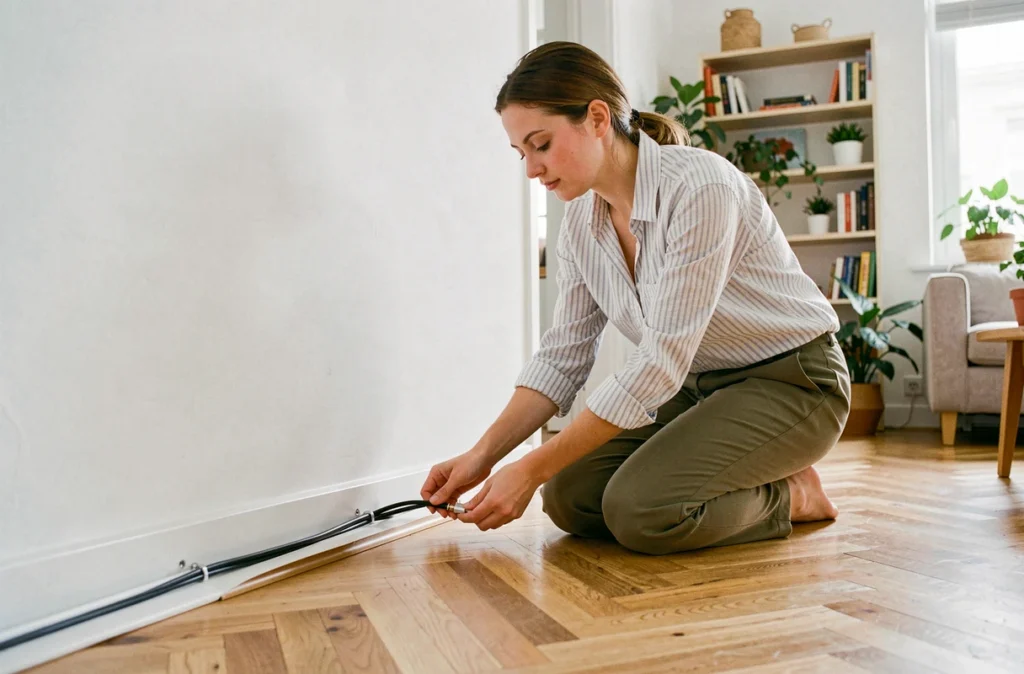
The adhesive cable duct can be installed in a few minutes. You slide the HDMI cable, power cable, and possibly an extension coaxial cable into it. To keep the result neat, choose a color that matches the wall and follow the angles of the baseboard or ceiling.
The adhesive holds on most smooth paints. On a textured or rough wall, the adhesion decreases significantly: in this case, a temporary fixing point (repositionable adhesive putty) reinforces the duct at the corners without leaving a mark.
Routing behind a piece of furniture or shelf
When the screen is placed on a piece of furniture, run the cables behind the furniture itself, then along the baseboard to the existing wall outlet. A cable tie or adhesive clip keeps everything in place. This is the least visible solution and the easiest to dismantle.
Freestanding TV stand on a pedestal
Freestanding mounts allow you to fix the screen at height without touching the wall. Some models include a cable management system within the vertical post. You achieve a wall-mounted look without any drilling. The weight supported varies by model, so check compatibility with the size and weight of your television before purchasing.
Checklist before starting installation in a rental
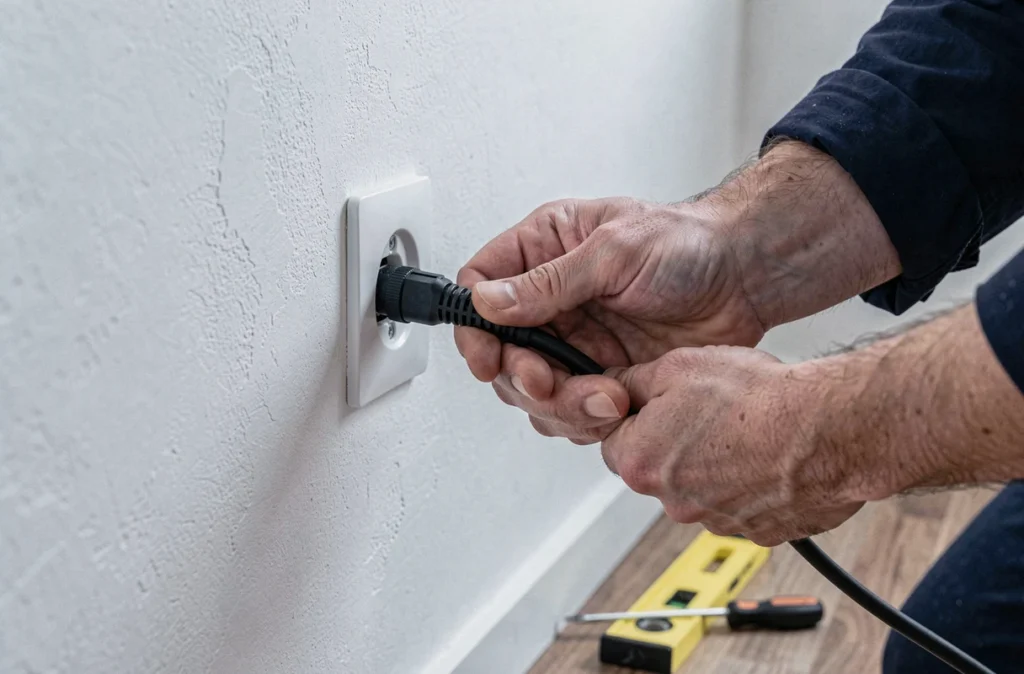
Before touching any cables, a few checks can prevent unpleasant surprises when returning the keys.
- Identify the type of TV connection present in the property (coaxial, fiber, box only) to choose the right extension cable or adapter
- Photograph the condition of the walls and existing outlets upon entering the property, to have proof in case of a dispute over the security deposit
- Check that the chosen ducts or adhesives are compatible with the wall covering (matte paint, satin, wallpaper, textured) to avoid damaging the finish upon removal
- Request the landlord’s written consent as soon as the installation exceeds simple temporary connection, especially for any work on the electrical circuit
The question of restoration also arises for small holes. Two or three anchor holes in a load-bearing wall can be easily filled with plaster, but on drywall, poorly done filling remains visible. In a rental, drilling should remain the last resort, not the first reflex.
Connecting TV in a rented apartment often boils down to a cable routing issue, not wall mounting. With a well-placed duct and a freestanding mount, you achieve a clean installation that can be dismantled in ten minutes on moving day, without any deductions from the deposit.